Style
How to judge fabric and clothing quality before you buy
Quality is not a mystery reserved for people who work in fashion. Most of it can be assessed in about ninety seconds, with your hands.
By Timisma · Published
What to know
- Read the composition label first: fibre content sets the limits of how a garment can behave.
- Weight and density matter more than fibre name — thin wool and dense cotton both exist.
- Seams, hems, linings and the inside of a garment reveal how carefully it was made.
- Price signals brand position and margin as much as construction; assess the garment, not the ticket.
- Care requirements are part of quality: a beautiful garment you won't maintain is a bad purchase.
In this article
Two garments on the same rail, similar price, similar look. One is still in shape in three years and the other is misshapen after four washes. The difference is nearly always visible before you buy, and it takes about ninety seconds to check.
Start with the composition label
Fibre content sets the outer limits of what a garment can do. It doesn't guarantee quality — there is poor wool and excellent cotton — but it tells you how the thing will behave when worn, washed and stored.
Natural fibres
Wool insulates while remaining breathable, resists creasing and springs back into shape; merino is finer against the skin, and lambswool is generally softer than a coarse general-purpose wool. Cotton is breathable and durable but creases and can lose shape without some structure. Linen is cool, extremely durable and creases by nature — that is the fibre working as intended, not a defect. Silk drapes beautifully and is more demanding to care for.
Synthetics and blends
Polyester, nylon, acrylic and elastane are not automatically bad. They add durability, stretch recovery and water resistance, and they are the right choice for sportswear and outerwear. What they do less well is breathe, which is why a polyester shirt is uncomfortable on a hot day and a polyester coat lining is often clammy.
In blends, the proportions matter. A few percent of elastane in a jean helps it recover its shape; a high proportion in a knit tends to sag over time. Viscose and its relatives — modal, lyocell, rayon — drape well and feel cool, but weaker versions lose strength when wet and shrink or distort if washed carelessly.
Weight and density
Hold the garment up to the light. If you can see clearly through the body of a supposedly opaque piece, it will be see-through in daylight and will likely be worn once and abandoned.
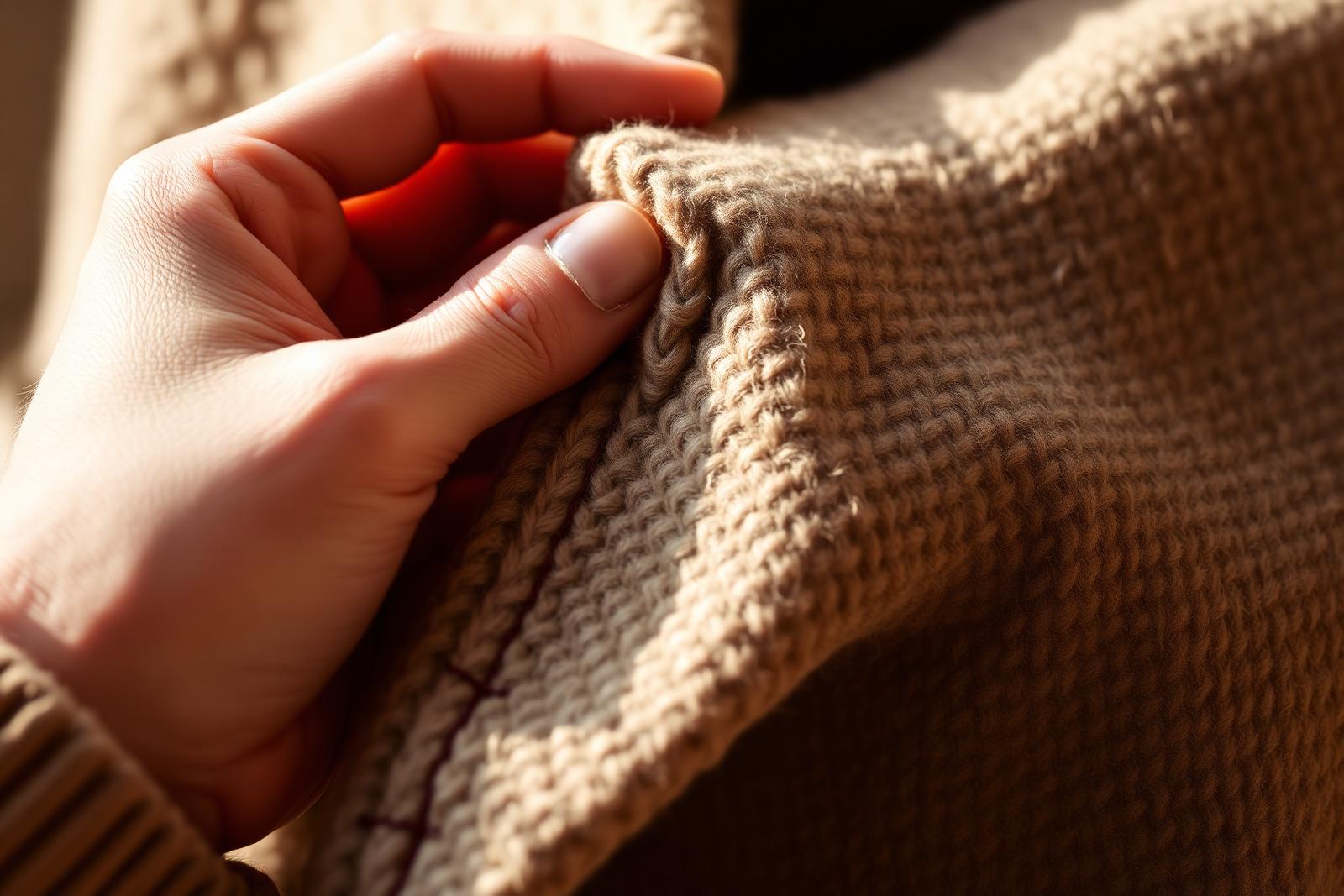
Squeeze a section of knitwear in your fist and release it. A denser, better-made knit springs back with the creases falling out; a loose or over-processed one stays crumpled. Rub a knit gently between your fingers — an immediate cloud of loose fibres suggests it will pill quickly.
For wovens, weight generally correlates with structure and longevity, particularly in trousers, jackets and coats. A jacket that feels weightless in the hand rarely holds its shape on the body.
Look at the inside
Turn the garment inside out. This is where cost-cutting is visible, because most shoppers never do it.
- Seams: stitches should be small, even and straight, with no puckering along the line. Raw edges should be finished — overlocked, bound or enclosed — rather than fraying.
- Hems: a deep hem hangs better and can be let down. A narrow, hard-pressed or glued hem cannot be altered.
- Pattern matching: on stripes and checks, look at the side seams and the point where a sleeve joins the body. Matched patterns take more fabric and more care.
- Buttons and fastenings: buttons should be securely stitched, ideally with a shank on thicker fabrics, and a spare should be included. Zips should run smoothly in both directions without catching.
- Stress points: pockets, cuffs, plackets and the base of a zip should be reinforced with extra stitching or a bar tack.
- Grain: hold the garment by the shoulders and let it hang. Side seams should fall straight rather than spiralling around the body.
Lining
A lining does real work: it helps a garment hold its shape, lets it slide over other layers, and protects the outer fabric. In tailoring, a fully lined jacket usually indicates a more considered construction than an unlined or half-lined one at the same price.
Check that the lining moves with the outer fabric rather than pulling against it, and that it isn't already twisting at the hem. A cheap, clingy lining in a wool coat is a warning about the rest.
What actually fails first
Garments rarely fail in the middle of a panel. They fail where friction and tension are concentrated: underarms, inner thighs, elbows, cuffs, pocket openings, the seat of trousers, the seam over the shoulder of a coat. Look hardest at those places, and check whether the fabric there is already thin.
Ask, too, whether a repair would be possible. A wool coat with a torn lining can be relined. A bonded, glued or heavily fused garment usually cannot be repaired at all.
Care requirements are part of the decision
The care label tells you what owning this will involve. Dry-clean-only is a genuine ongoing cost and a barrier to wearing something often. Hand-wash-and-reshape-flat is fine if you will do it and pointless if you won't.
This is worth taking seriously rather than intending to improve. A silk blouse you avoid wearing because of the ironing is a worse purchase than a washable one you wear weekly.
Why price is a weak signal
Price reflects brand positioning, marketing, retail location, margin, and where and how something was made. Construction is only one input among several.
Expensive garments made cheaply are common; so are well-made garments at moderate prices, particularly in plain, unfashionable categories where nobody is paying for a name. The advantage of checking fabric, seams and finishing yourself is that it works in both directions — it stops you overpaying, and it lets you recognise something genuinely good on a rail nobody else is looking at.
Related reading
Style
How to build a wardrobe you actually wear
A practical method for building a wardrobe around the life you have: auditing what you repeat, fixing fit, identifying real gaps and buying less often.

Life
How to set boundaries at work without over-explaining yourself
Practical language for managing availability, workload and expectations at work — including how to say no, and how to stop justifying every limit you set.